If you have searched for "THC detox," you have probably encountered a wall of dubious products and conflicting advice. Detox drinks, niacin mega-doses, activated charcoal, apple cider vinegar cleanses — the list is endless. Most of it is marketing. Here is what peer-reviewed research actually tells us about how THC leaves your body and what you can do about it.
How THC Is Stored in Your Body
THC detox takes weeks to months because THC is fat-soluble and accumulates in adipose tissue with repeated use. According to Dr. Marilyn Huestis of the National Institute on Drug Abuse, “THC is highly lipophilic and initially taken up by tissues that are highly perfused, such as the lung, heart, brain, and liver” before concentrating in fat stores (Chemistry and Biodiversity, 2007). A study in Drug and Alcohol Dependence (Lowe et al., 2009) documented “extended excretion of THC and 11-OH-THC for at least 24 days” in chronic users during monitored abstinence. Unlike water-soluble substances like alcohol (cleared in hours) or cocaine (cleared in days), THC-COOH is slowly released from fat cells over weeks, creating the longest detection window of any commonly used substance.
THC (delta-9-tetrahydrocannabinol) is lipophilic — it dissolves in fat, not water. When you consume cannabis, THC is rapidly absorbed into your bloodstream and distributed throughout your body. What is not immediately metabolized gets stored in adipose (fat) tissue.
Your liver converts THC into metabolites, primarily THC-COOH (11-nor-9-carboxy-THC), which is what most drug tests detect. THC-COOH is also fat-soluble and accumulates with repeated use. This is why daily users test positive far longer than occasional users — they have more THC-COOH stored in their fat cells.
The release of stored THC-COOH back into the bloodstream happens slowly as fat cells are metabolized. This is why detection windows are measured in weeks rather than hours, and why there is no shortcut to truly clearing your system. Research published in Clinical Chemistry confirmed that chronic users can test positive for THC-COOH for over 30 days after cessation.
As Dr. Marilyn Huestis explains in her comprehensive pharmacokinetics review, “with prolonged drug exposure, THC concentrates in human fat, being retained for extended periods of time” (Chemistry and Biodiversity, 2007). Her team’s research confirmed extended excretion patterns of “at least 24 days” for THC metabolites in chronic users (Lowe et al., Drug and Alcohol Dependence, 2009).
THC Detox Timeline by Usage Level
Detection windows vary significantly based on usage patterns, body fat percentage, metabolism, and the type of test:
| Usage Level | Urine Test | Blood Test | Saliva Test | Hair Test |
|---|---|---|---|---|
| Single use | 3–4 days | 1–2 days | 1–3 days | Up to 90 days |
| Moderate (3–4x/week) | 5–7 days | 2–3 days | 1–3 days | Up to 90 days |
| Daily use | 10–15 days | 7+ days | 1–4 days | Up to 90 days |
| Heavy daily use | 30–90+ days | 14+ days | 1–7 days | Up to 90 days |
These are estimates. A 2009 study in the Journal of Analytical Toxicology found that 25% of heavy users still tested positive after 30 days. Body composition matters: people with higher body fat percentages retain THC-COOH longer because there is simply more storage space.
What Actually Speeds Up THC Detox
1. Time
The most reliable method. Your body metabolizes stored THC-COOH at a relatively fixed rate determined by your metabolism, liver function, and activity level. There is no substitute for time.
2. Exercise
Physical activity burns fat cells, releasing stored THC-COOH into the bloodstream for elimination. Regular cardio and strength training can modestly accelerate the process. Important caveat: exercising in the 24–48 hours before a drug test can temporarily increase THC-COOH levels in your urine as fat is mobilized. If you are testing soon, avoid intense exercise in the days immediately before.
3. Hydration
Staying well-hydrated supports kidney function and normal metabolite excretion. This does not flush THC out faster — it ensures your body is operating efficiently. Over-hydrating (water loading) before a test can dilute your sample, but most labs test for dilution and will flag it as invalid.
4. Diet
A balanced diet that supports liver function and healthy metabolism helps. There is no magic food that eliminates THC. High-fiber diets may marginally help because some THC metabolites are excreted through bile into the intestines.
What Does Not Work
Detox kits and drinks
Most commercial "THC detox" products are diuretics with added vitamins and creatine. They work by temporarily diluting your urine and adding creatinine (which labs check to detect dilution). They do not remove THC from your fat cells. At best, they mask a test temporarily. At worst, they waste your money and give a false sense of security.
Niacin (Vitamin B3) mega-doses
This persistent myth has led to actual hospitalizations. High-dose niacin causes liver damage, skin flushing, and does not meaningfully accelerate THC clearance. The idea comes from the fact that niacin affects lipid metabolism, but the doses needed to impact fat burning are toxic.
Cranberry juice, apple cider vinegar, pickle juice
None of these have any scientific support for THC elimination. They are folk remedies that persist because of anecdotal reports and confirmation bias.
Saunas and sweat
THC is excreted primarily through urine and feces, not sweat. While saunas have other health benefits, sweating does not meaningfully accelerate THC detox. A study in Archives of Toxicology confirmed that sweat contributes negligibly to THC elimination.
Drug Testing: Urine, Blood, Hair, Saliva
Urine tests (most common)
Standard cutoff: 50 ng/mL for THC-COOH. This is the most common workplace and probation test. The immunoassay screening is cheap and fast; positive results are confirmed with GC-MS at a 15 ng/mL cutoff.
Blood tests
Detect active THC (not just metabolites). Shorter detection window. Used primarily for DUI testing and clinical settings. THC drops below detectable levels in blood within days for occasional users.
Saliva tests
Growing in popularity for roadside and workplace testing. Detect THC itself (not metabolites) with a short window of 1–7 days. Less reliable for detecting past use.
Hair tests
Standard testing covers 1.5 inches of hair (approximately 90 days of growth). Hair tests detect THC metabolites incorporated into the hair shaft. They are the hardest to beat and are used in high-security and legal contexts. However, they have higher false-positive rates and can be affected by environmental exposure.
Detox vs. Recovery: Why They Are Different
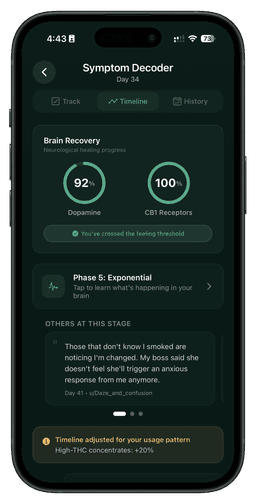
THC detox (metabolite clearance) and cannabis recovery (brain healing) are distinct processes that follow different timelines. Detox refers to how long THC-COOH remains detectable — chronic users may test positive for 30–90+ days (Bergamaschi et al., Clinical Chemistry, 2013). Recovery refers to neurological healing: CB1 receptor normalization takes approximately 28 days in cortical regions (Hirvonen et al., Molecular Psychiatry, 2012), while dopamine system recalibration extends to 60–90 days (Bloomfield et al., Molecular Psychiatry, 2016). You can pass a drug test and still experience withdrawal symptoms including insomnia, irritability, and cravings. Conversely, your brain may feel recovered while metabolites linger in fat tissue. Tools like Klar focus on tracking the recovery that drug tests cannot measure.
Clearing THC from your system (detox) and recovering from cannabis dependency (recovery) are related but distinct processes.
Detox is about metabolite clearance — how long until THC-COOH is undetectable. This is primarily a pharmacokinetic process driven by your body composition and metabolism.
Recovery is about neurological healing — your CB1 receptors upregulating, your dopamine system recalibrating, your sleep architecture normalizing. This process follows a different timeline and is what determines when you actually feel better.
You can pass a drug test and still be in the middle of withdrawal. The withdrawal symptoms — insomnia, irritability, anxiety — are driven by receptor changes, not by THC levels in your fat cells.
If your goal is genuine recovery rather than just passing a test, the focus should be on supporting your brain through the 90-day recovery process rather than chasing detox shortcuts.
Frequently Asked Questions
Can I speed up THC detox naturally?
Modestly, through exercise and a healthy diet. But the effect is small compared to simply waiting. For heavy users, expect 30–90+ days regardless of what you do.
Do detox drinks work for drug tests?
They may temporarily dilute urine, but modern labs test for dilution. They do not remove THC from your body. They are not reliable for passing a test.
How long does one hit of weed stay in your system?
For an otherwise clean person, a single use is typically undetectable in urine within 3–4 days. In blood, 1–2 days. In saliva, 1–3 days. Hair tests may detect it for up to 90 days.
Does body fat affect how long THC stays in your system?
Yes. THC-COOH is stored in fat cells. People with higher body fat percentages retain THC metabolites longer. Weight loss can temporarily spike THC-COOH levels in urine as fat is broken down.
Is a "THC detox" the same as quitting weed?
No. Detox refers to metabolite clearance. Quitting involves managing withdrawal symptoms and building new habits. You can detox without recovery, but you cannot recover without detox. Klar focuses on the recovery side — helping you understand and navigate the neurological changes that happen when you stop using cannabis.