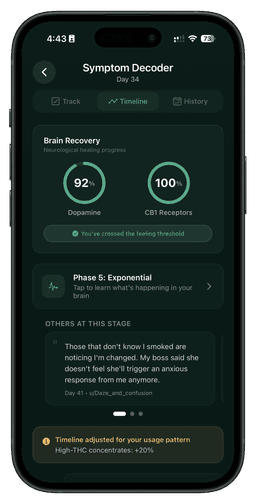
There's a reason everything feels grey when you quit cannabis. It's not that life is actually grey—it's that your brain has temporarily lost the ability to register color. Understanding exactly what's happening in your brain during recovery is one of the most powerful tools you have.
This isn't abstract neuroscience. This is what's happening inside your head right now, and it directly explains why you feel the way you do.
Two Systems, One Story
Cannabis recovery involves two brain systems: the dopamine reward system and the endocannabinoid (CB1 receptor) system. Regular cannabis use causes deficits in striatal dopamine release (Bloomfield et al., Molecular Psychiatry, 2016) and CB1 receptor downregulation (Hirvonen et al., Molecular Psychiatry, 2012). Both systems recover at different rates, with CB1 receptors normalizing by approximately day 28 and full dopamine recovery taking 60–90 days.
Cannabis recovery involves two major brain systems that work together:
- The dopamine system — your reward and motivation engine
- The endocannabinoid system — your balance and homeostasis keeper
Both are disrupted by regular cannabis use. Both recover. But they recover at different rates, which explains the rollercoaster of early sobriety.
The Dopamine System: Your Reward Engine
Dopamine depletion after quitting cannabis causes anhedonia — the inability to feel pleasure from everyday activities. A 2016 study in Molecular Psychiatry found that chronic cannabis users have significantly reduced dopamine synthesis capacity in the striatum. This deficit is reversible: dopamine receptor density begins recovering within 2 weeks, with substantial recovery by day 28 and full normalization by 60–90 days of abstinence.
Dopamine isn't about pleasure—it's about wanting. It's the neurotransmitter that makes things feel interesting, worth pursuing, and rewarding. When dopamine levels are healthy, everyday activities—a good meal, a productive conversation, completing a task—feel satisfying.
Your brain has about 86 billion neurons, and dopamine-producing neurons are concentrated in two key areas:
The Ventral Tegmental Area (VTA)
This is where dopamine is manufactured and sent to the nucleus accumbens—your brain's "reward center." When you eat something delicious, achieve a goal, or experience something novel, the VTA fires and floods the nucleus accumbens with dopamine. That rush of satisfaction? That's this circuit.
The Prefrontal Cortex Connection
Dopamine also flows to the prefrontal cortex, supporting motivation, planning, and impulse control. When dopamine is depleted, you don't just feel less pleasure—you feel less capable of making decisions and following through on plans. This is why recovery requires more than willpower.
The Endocannabinoid System: Your Balance Keeper
Your body produces its own cannabinoids. The two main ones are:
- Anandamide (the "bliss molecule") — involved in mood regulation, pain modulation, and appetite
- 2-AG (2-Arachidonoylglycerol) — involved in immune function, inflammation, and neural signaling
These endocannabinoids bind to CB1 receptors (concentrated in the brain) and CB2 receptors (concentrated in the immune system). Think of CB1 receptors as locks and endocannabinoids as keys. In a healthy system, the right amount of keys fit the right number of locks, keeping everything balanced.
What THC Does to Both Systems
THC is structurally similar to anandamide—similar enough to fit into CB1 receptor locks. But THC is far more potent than anandamide and stays in the system much longer. Here's what happens with regular use:
Phase 1: Tolerance (Weeks to Months)
Your brain registers that CB1 receptors are being overstimulated. In response, it downregulates—reducing the number of CB1 receptors on cell surfaces. You need more THC to achieve the same effect. This is tolerance.
Phase 2: Dependency (Months to Years)
Simultaneously, your brain reduces its own anandamide and 2-AG production (why bother making keys when someone's flooding the system with master keys?). Your dopamine baseline drops because your VTA has recalibrated to expect THC-level stimulation.
Now you have: fewer CB1 receptors, less natural endocannabinoid production, and a reduced dopamine baseline. Your brain is optimized for a world that includes THC. Remove it, and the system crashes.
Phase 3: Withdrawal
Without THC, you have insufficient receptor activation (too few receptors, too few natural cannabinoids) and depleted dopamine. Everything that makes life feel interesting, manageable, and pleasurable is running at 40–60% capacity. This is why withdrawal feels like the world went from HD to standard definition.
The Recovery Arc
Here's the hopeful part: your brain is remarkably good at fixing itself.
CB1 Receptor Recovery
Neuroimaging studies using PET scans show that CB1 receptor density begins increasing within 48 hours of abstinence. By Day 28, there's substantial recovery in most brain regions. By Day 90, receptor density is statistically indistinguishable from never-users in most studies.
Dopamine Recovery
Dopamine synthesis capacity follows a slower curve. Measurable improvement begins around Day 14, with significant gains by Day 28. Full normalization typically occurs between Day 60–90. This lag is why the Valley of Disappointment exists—your endocannabinoid system has recovered enough to stop acute withdrawal, but dopamine hasn't caught up yet.
Natural Endocannabinoid Recovery
Your body gradually restores anandamide and 2-AG production as CB1 receptors return. This process is less well-studied but appears to parallel receptor recovery. Exercise is the most reliable way to boost natural endocannabinoid production during recovery.
Accelerating Brain Recovery
While you can't rush neurobiology, you can create conditions that support faster recovery:
Exercise is the #1 intervention. Aerobic exercise directly increases anandamide levels (the "runner's high" is actually an endocannabinoid phenomenon, not endorphins). It also boosts BDNF (brain-derived neurotrophic factor), which accelerates neural repair.
Sleep is when your brain does its repair work. Prioritizing sleep hygiene—even when sleep is disrupted—supports neuroplasticity.
Novel experiences stimulate dopamine through the novelty pathway—a separate circuit from substance-induced dopamine. New hobbies, new routes to work, new music—anything that breaks patterns activates this circuit.
Social connection triggers oxytocin release, which interacts synergistically with dopamine. Isolation is recovery's enemy; connection is its ally.
Omega-3 fatty acids (from fish, walnuts, or supplements) support CB1 receptor membrane integrity. Some studies suggest they may accelerate receptor recovery.
Your brain is healing right now. You can't see it, but the data is clear: every day of abstinence is a day of measurable neurological recovery. The flat, grey feeling isn't permanent. It's your brain in the process of remembering what it's like to run on its own.