Irritability After Quitting Weed
Last updated: January 31, 2026
Feeling easily angered, short-tempered, or snapping at people is a direct result of your brain's stress response system running on overdrive during withdrawal.
50-60% of people quitting cannabis
Peaks day 4
~Peaks day 21
Recovery Timeline
| Metric | Value |
|---|---|
| Prevalence among quitters | 50-60% of people quitting cannabis |
| Typical onset | Day 1 |
| Peak intensity | Day 4 |
| Expected resolution | ~Day 21 |
| Total duration | 20 days (approximate) |
Someone chews too loudly and you want to scream. Your partner asks a simple question and you snap. A minor inconvenience feels like a personal attack. You’re not becoming a worse person — your brain is going through a neurochemical adjustment that temporarily amplifies every emotional signal.
Why Quitting Weed Causes Irritability
THC has a sedating, emotion-dampening effect. It blunts the amygdala’s response to perceived threats and enhances GABA (your brain’s calming neurotransmitter). For regular users, cannabis becomes the default emotional regulation tool — instead of processing frustration naturally, you smoke and the feeling dissolves.
When you quit:
- Your amygdala becomes hyperactive. Without THC suppressing it, your brain’s threat-detection system overreacts to minor stimuli. Things that shouldn’t be threatening feel intensely aggravating.
- Cortisol surges. Withdrawal increases cortisol (the stress hormone) by 30–50% above baseline during the first week. You’re physiologically in a stress state even when nothing stressful is happening.
- Emotional regulation skills have atrophied. If you’ve been using cannabis to manage emotions for years, the neural pathways for natural emotion regulation are underdeveloped. You’re essentially re-learning how to handle frustration without a chemical buffer.
When Does It Start, Peak, and End?
- Onset: Day 1. Often the very first symptom people notice.
- Peak: Days 2–6. This is when you’re most likely to snap at people, slam doors, or feel rage over minor things.
- Improvement: Days 7–14. The intensity decreases noticeably.
- Resolution: Days 14–28 for most. Your prefrontal cortex regains its ability to modulate amygdala responses.
What Actually Helps
1. Warn the People Around You
Tell your partner, family, or roommates: “I’m quitting cannabis and I’m going to be irritable for a couple of weeks. It’s neurological, not personal. If I snap, call me on it gently.” This single step prevents most relationship damage during withdrawal.
2. Physical Release
Irritability is excess energy in the nervous system. Give it somewhere to go: intense exercise, punching a pillow, even vigorous cleaning. The goal is to discharge the physical activation so it doesn’t come out as anger at people.
3. The 10-Second Rule
When you feel the spike of irritation, count to 10 before responding. This gives your prefrontal cortex time to override the amygdala’s snap reaction. It sounds simple because it is — and it works because irritability during withdrawal is fast and shallow, not deep.
4. Reduce Stimulation
Noise, crowds, multitasking, and social media all pile on stimulation that your oversensitive nervous system can’t handle right now. Simplify your environment during the first two weeks. Fewer inputs = fewer triggers.
5. HALT Check
When irritation spikes, ask: am I Hungry, Angry (about something specific), Lonely, or Tired? These basic needs amplify withdrawal irritability. Addressing the underlying need often resolves the irritation immediately.
When to Seek Professional Help
- Anger is escalating to aggression (breaking things, threatening people)
- Irritability is causing serious relationship or work problems
- You’re having violent thoughts or urges
- Irritability persists beyond 4 weeks with no improvement
SAMHSA National Helpline: 1-800-662-4357 (free, confidential, 24/7)
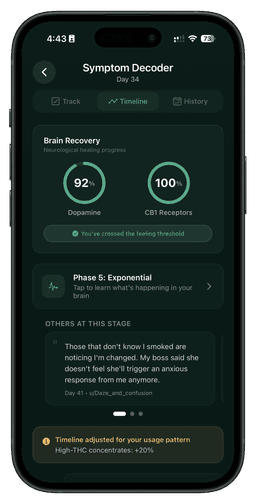
Track your progress
See your brain healing in real time
Klar tracks 47 withdrawal symptoms and visualizes your dopamine and CB1 receptor recovery day by day.
Related Symptoms
Medical Disclaimer: This content is for informational purposes only and does not constitute medical advice, diagnosis, or treatment. Always consult a qualified healthcare provider for medical guidance. If you are in crisis, call 988 (Suicide & Crisis Lifeline) or text HOME to 741741.