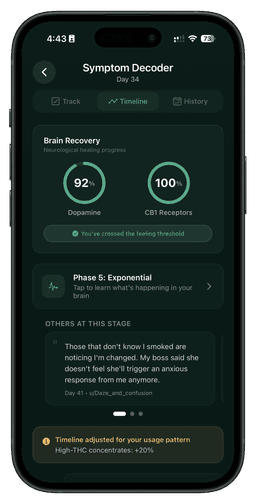
When you quit cannabis, your brain doesn't flip a switch back to normal. It rebuilds—slowly, methodically, following a timeline that neuroscience has mapped with increasing precision. Understanding this timeline is one of the most powerful tools in your recovery.
Why 90 Days? The Science
The 90-day cannabis recovery timeline is grounded in neuroimaging research showing CB1 receptor normalization. A landmark PET imaging study published in Molecular Psychiatry (Hirvonen et al., 2012) demonstrated that CB1 receptor density in chronic daily cannabis smokers begins recovering within 48 hours of abstinence, with significant normalization by day 28 in cortical regions. As the researchers concluded, this represents "the first direct demonstration of cortical cannabinoid CB1 receptor downregulation as a neuroadaptation that may promote cannabis dependence in human brain." Parallel dopamine research shows striatal dopamine synthesis capacity recovering over 4–12 weeks (Bloomfield et al., Molecular Psychiatry, 2016), explaining why motivation and pleasure gradually return during the second and third months of abstinence.
The 90-day figure isn't motivational fluff. It comes from neuroimaging studies tracking CB1 receptor density in regular cannabis users after cessation. A landmark study published in Molecular Psychiatry showed that CB1 receptors begin upregulating within 48 hours of abstinence, with substantial recovery by Day 28 and near-complete normalization by Day 90.
As Dr. Jussi Hirvonen and colleagues at the National Institute of Mental Health demonstrated: "After approximately 4 weeks of continuously monitored abstinence from cannabis on a secure research unit, CB1 receptor density returned to normal levels" (Hirvonen et al., Molecular Psychiatry, 2012). Full functional recovery, including dopamine normalization, extends this timeline to approximately 90 days.
Parallel research on dopamine shows a similar arc. Regular THC exposure reduces dopamine synthesis capacity in the striatum. Recovery follows a curve—rapid initial improvement, then a slower climb to baseline. Most studies converge on the 8–12 week window for functional normalization.
Here's what each phase looks like.
Days 1–3: The First 72 Hours
What's happening in your brain: THC is still clearing from your fat cells. Your endocannabinoid system is registering the absence. CB1 receptors begin upregulating within 48 hours—your brain is already starting to rebuild.
What you'll feel:
- Irritability and restlessness (your brain is understimulated)
- Difficulty falling asleep (THC was suppressing REM sleep—now it's coming back)
- Decreased appetite (cannabis was artificially stimulating hunger signaling)
- Mild anxiety as your body adjusts
What helps: Stay hydrated. Light exercise (even a 20-minute walk) boosts natural endocannabinoid production. Avoid caffeine after noon. This is a great time to lean on the distraction strategy—stay busy.
Days 4–7: Peak Physical Withdrawal
What's happening in your brain: Your body is at peak withdrawal. Cortisol levels are elevated. Night sweats are your body expelling stored THC metabolites through sweat glands. Your endocannabinoid system is in active recalibration.
What you'll feel:
- Night sweats (often intense—this is normal)
- Vivid dreams or nightmares (REM rebound—your brain is catching up on suppressed dream sleep)
- Insomnia peaking this week
- Emotional volatility—crying, anger, or numbness
- Physical symptoms: headaches, stomach discomfort, shakiness
What helps: This is the hardest physical week. Remind yourself: this is temporary. Every symptom is evidence that your brain is recalibrating. Hot showers before bed. Magnesium glycinate (200–400mg) for sleep. No major life decisions this week.
Week 2: The Psychological Shift
What's happening in your brain: Physical symptoms begin easing. Dopamine receptor sensitivity is starting to recover. But psychological symptoms—anxiety, depression, brain fog—often intensify. This is because your prefrontal cortex is coming back online but isn't fully functional yet.
What you'll feel:
- Brain fog and difficulty concentrating
- Waves of anxiety or depression
- Intense boredom (your reward system doesn't know what to do without THC)
- Cravings that feel overwhelming but are actually less frequent than Week 1
- Sleep improving slightly—still not normal
What helps: Structure your days. Boredom is a major relapse trigger. Exercise is your best friend—it naturally boosts dopamine, serotonin, and endorphins. Start craving surfing—by now you'll notice the 20-minute window.
Weeks 3–4: The Valley of Disappointment
Weeks 3–4 of cannabis recovery represent the highest-risk period for relapse, when acute withdrawal has resolved but dopamine recovery is incomplete. At day 28, CB1 receptor density has recovered substantially in cortical regions (Hirvonen et al., Molecular Psychiatry, 2012), but dopamine baseline remains below normal. This mismatch produces anhedonia — the inability to feel pleasure from everyday activities. Cannabis withdrawal is clinically characterized by “a time-dependent constellation of symptoms: irritability, anxiety, marijuana craving, decreased quality and quantity of sleep, and decreased food intake” (Haney, Current Psychiatry Reports, 2005). More people relapse between days 21–45 than at any other time because the acute urgency to quit has faded while neurological recovery remains incomplete.
What's happening in your brain: Your brain is in active reconstruction. CB1 receptor density is significantly improved. Dopamine is climbing but hasn't normalized. This gap between "no longer acutely withdrawing" and "not yet feeling good" is what we call the Valley of Disappointment.
What you'll feel:
- A dangerous feeling of "I should feel better by now"
- Flat emotions—not depressed, but not happy either
- Questioning whether quitting is worth it
- Romanticizing past use ("it wasn't that bad")
- Moments of clarity breaking through
This is the highest-risk period for relapse. More people give up between Days 21–45 than at any other time. The acute pain is gone, so the urgency to quit fades. But you're not healed yet.
What helps: Read this timeline again. Know that this valley is a mapped, expected, temporary phase. The people who make it through this window have dramatically higher success rates. Lean on tracking—look at your progress data. You've come too far.
Weeks 5–8: The Gradual Return
What's happening in your brain: Dopamine synthesis capacity is approaching normal levels. Sleep architecture is restructuring—you're getting more restorative deep sleep. Cognitive function measurably improves. Your prefrontal cortex is reasserting control over impulse and decision-making.
What you'll feel:
- Mornings that feel easier
- Genuine moments of enjoyment without substances
- Improved memory and focus
- Sleep normalizing (still not perfect)
- Cravings less frequent—maybe a few times a week instead of constantly
- Emotional range returning—you might cry at a movie and actually enjoy it
What helps: This is when lifestyle changes start to stick. New hobbies, exercise routines, social patterns—your brain is now capable of forming new reward pathways. Build the life you want to live, not just the one that avoids cannabis.
Weeks 9–12: Clarity Emerges
What's happening in your brain: CB1 receptor density is near-baseline. Dopamine system is functionally recovered. Sleep cycles have normalized. Your endocannabinoid system is producing anandamide and 2-AG at healthy levels again.
What you'll feel:
- Mental clarity that you forgot was possible
- Stable mood without artificial support
- Dreams that have settled from vivid/disturbing to normal
- Natural energy levels returning
- Occasional cravings—brief and manageable
- A sense of pride and accomplishment that's genuinely earned
What helps: Celebrate, but stay vigilant. The neural pathways for cannabis use still exist—they just aren't dominant anymore. Continue the practices that got you here. Many people find this is when they can articulate why they quit, not just that they did.
Beyond Day 90
Day 90 isn't the end—it's the beginning of maintenance. Your brain is functionally recovered, but long-term neural plasticity means the old pathways can be reactivated by stress, environment, or social triggers. The skills you've built—craving surfing, identity awareness, symptom tracking—become lifelong tools.
Most long-term successful quitters report that by Month 6, they rarely think about cannabis. By Year 1, it feels like a different life.
Factors That Affect Your Timeline
This timeline is a general framework. Your personal experience may be faster or slower based on:
- Duration of use: Longer use = longer recovery (more neuroadaptation to reverse)
- Frequency: Daily users typically experience more withdrawal than weekly users
- Potency: High-THC concentrates create deeper dependency
- Age of onset: Those who started before 18 may have a longer timeline
- Exercise: Regular exercise accelerates recovery across all metrics
- Sleep quality: Prioritizing sleep hygiene speeds up brain recovery
- Mental health: Pre-existing anxiety or depression can extend the timeline
Track your own data. Your timeline is yours—and understanding it is half the battle.