Whether you’re facing a drug test, starting a new job, or simply curious about what’s happening in your body after quitting, the question "how long does weed stay in your system?" has a frustratingly complicated answer. It depends on the test, your body, and how much you used. Here’s what the science actually says.
How Your Body Processes THC
THC stays in your system longer than almost any other commonly used substance because it is lipophilic — it dissolves in fat, not water. As Dr. Marilyn Huestis of the National Institute on Drug Abuse documented, “THC is highly lipophilic and initially taken up by tissues that are highly perfused, such as the lung, heart, brain, and liver” before accumulating in adipose tissue (Chemistry and Biodiversity, 2007). This fat storage mechanism means chronic daily users can test positive for THC-COOH (the primary metabolite drug tests detect) for 30–77 days after last use. A study published in Clinical Chemistry (Bergamaschi et al., 2013) found that 4 of 5 chronic cannabis smokers remained THC-COOH positive after 30 days of monitored abstinence.
When you consume cannabis, delta-9-THC enters your bloodstream and quickly distributes to your brain (producing the high), then to organs and fat tissue. Your liver metabolizes THC into several compounds, the most important being THC-COOH (11-nor-9-carboxy-THC) — this is the metabolite most drug tests detect.
Here’s what makes cannabis different from almost every other substance: THC is lipophilic (fat-soluble). It accumulates in fat cells throughout your body. As your body metabolizes fat, THC-COOH is slowly released back into the bloodstream and eventually excreted through urine and feces.
This fat storage mechanism is why cannabis has the longest detection window of any commonly used substance. Alcohol clears in hours. Cocaine in days. THC metabolites can persist for weeks or even months in heavy users.
As Dr. Marilyn Huestis, formerly of the National Institute on Drug Abuse, explains in her comprehensive pharmacokinetics review: “with prolonged drug exposure, THC concentrates in human fat, being retained for extended periods of time.” Her team’s research confirmed that 4 of 5 chronic daily cannabis smokers remained THC-COOH positive after 30 days of abstinence (Bergamaschi et al., Clinical Chemistry, 2013).
Detection Times by Test Type
Urine Test (Most Common)
Urine tests detect THC-COOH and are the standard for workplace drug screening. The standard cutoff is 50 ng/mL (nanograms per milliliter).
| Usage Pattern | Detection Window |
|---|---|
| Single use | 3–8 days |
| Moderate use (4x/week) | 5–18 days |
| Daily use | 15–30 days |
| Heavy daily use (multiple times/day) | 30–77 days |
A study published in Journal of Analytical Toxicology found that some chronic users tested positive up to 77 days after last use. However, most daily users clear the 50 ng/mL threshold within 21–30 days.
Blood Test
Blood tests detect active THC (not just metabolites) and are used primarily in DUI cases and medical settings.
- Single use: 1–2 days
- Regular use: 2–7 days
- Heavy daily use: Up to 25 days (THC-COOH remains detectable longer than active THC)
Active THC drops to nearly undetectable levels within hours of consumption. Blood tests primarily catch recent use, not historical use.
Saliva Test
Saliva (oral fluid) tests are increasingly used for roadside testing and some workplace screenings. They detect parent THC rather than metabolites.
- Detection window: 24–72 hours for most users
- Heavy users: May test positive for up to 72 hours
Saliva tests have the shortest detection window of any test type, making them effective only for detecting very recent use.
Hair Test
Hair follicle tests detect THC-COOH that has been deposited in hair as it grows. The standard test analyzes 1.5 inches of hair (representing approximately 90 days of growth).
- Detection window: Up to 90 days (standard panel)
- Onset: Takes 5–10 days for THC to appear in new hair growth
Hair tests are the hardest to pass after regular use. However, they are also the most controversial — studies have shown higher false-positive rates for people with dark hair and potential for environmental contamination (secondhand smoke exposure).
Factors That Affect Detection
1. Body Fat Percentage
Since THC is stored in fat, people with higher body fat percentages retain THC metabolites longer. This is the single most significant individual variable. A lean person and an overweight person with identical usage histories can have dramatically different detection windows.
2. Metabolism and Exercise
Faster metabolism = faster clearance. Regular exercise burns fat (releasing stored THC) and increases metabolic rate. However, intense exercise close to a test can temporarily increase THC-COOH levels in urine as fat is burned and metabolites are released.
3. THC Potency and Consumption Method
Modern cannabis products vary enormously in THC concentration. Flower (15–25% THC), concentrates (60–90% THC), and edibles all produce different metabolite loads. Higher potency = more THC-COOH = longer detection. Edibles also produce the metabolite 11-hydroxy-THC, which may extend detection windows.
4. Hydration
Hydration affects urine concentration but does not speed up THC metabolism. Drinking water dilutes urine (reducing the ng/mL concentration), which can cause a test to fall below the cutoff — but labs check for excessive dilution using creatinine levels and specific gravity. A "dilute" result typically requires a retest.
5. Frequency and Duration of Use
The more you used and the longer you used, the more THC is stored in your fat tissue. A single use might clear in days. Years of daily use builds a significant reservoir that takes weeks to fully deplete.
Can You Speed Up THC Clearance?
The internet is full of "detox" products and shortcuts. Here’s what the evidence actually supports:
What works (somewhat):
- Time — The only guaranteed method. Your body will clear THC naturally.
- Exercise — Burns fat, releasing stored THC. Best done well before a test (not the day before, as it can temporarily spike levels).
- Hydration — Adequate water intake supports kidney function. Does not accelerate metabolism but supports normal clearance.
- Fiber — Some research suggests high-fiber diets increase fecal excretion of THC metabolites (approximately 65% of THC-COOH is eliminated through feces, not urine).
What does not work:
- "Detox drinks" and cleanses — No scientific evidence supports accelerated THC clearance from commercial detox products. Most work by temporarily diluting urine (same as drinking water).
- Niacin — A persistent myth. No evidence it speeds THC metabolism. High doses can cause liver damage.
- Vinegar, cranberry juice, goldenseal — None have any demonstrated effect on THC metabolite clearance.
- Saunas — Sweating eliminates negligible amounts of THC. The vast majority is cleared through liver metabolism and excretion.
THC Clearance vs. Brain Recovery
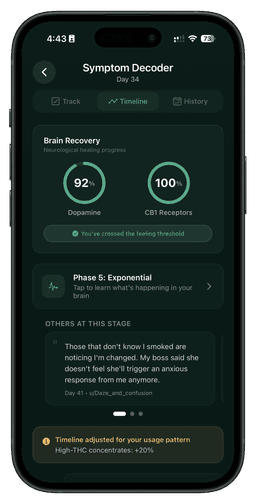
Passing a drug test is not the same as being recovered from cannabis — THC metabolite clearance and brain recovery follow different timelines. You might test clean at day 30 while your CB1 receptors and dopamine system are still in active recovery. PET imaging research shows CB1 receptor density begins recovering within 48 hours but doesn’t fully normalize until approximately day 90 (Hirvonen et al., Molecular Psychiatry, 2012). Dopamine synthesis capacity recovers over 4–12 weeks (Bloomfield et al., Molecular Psychiatry, 2016). As Dr. Huestis has documented, “with prolonged drug exposure, THC concentrates in human fat, being retained for extended periods of time” (Chemistry and Biodiversity, 2007) — but the metabolite in your urine tells you nothing about how your brain actually feels.
Here’s an important distinction many people miss: testing clean is not the same as being recovered.
You might pass a drug test at day 30 while your brain is still in the middle of recovery. THC-COOH in your urine tells you about metabolite clearance. It tells you nothing about CB1 receptor density, dopamine regulation, or sleep architecture — the systems that determine how you actually feel.
The 90-day brain recovery timeline tracks what actually matters for your wellbeing:
- CB1 receptors: Begin recovering at day 2, significant recovery by day 28, near-complete normalization by day 90
- Dopamine system: Gradual recovery over 4–12 weeks. The "Valley of Disappointment" (weeks 4–6) reflects the gap between testing clean and feeling normal.
- Sleep architecture: Insomnia and vivid dreams resolve over 2–6 weeks, independent of metabolite clearance.
If you’re quitting cannabis, tracking your withdrawal symptoms and brain recovery progress matters more than tracking your pee. Tools like Klar help you see the recovery that drug tests can’t measure.
Frequently Asked Questions
How long does one hit of weed stay in your system?
A single use is typically detectable in urine for 3–8 days, in blood for 1–2 days, and in saliva for 24–72 hours. This assumes no prior recent use. If you used regularly before this single use, detection times will be longer due to accumulated THC in fat tissue.
Does delta-8 THC show up on drug tests?
Yes. Standard urine tests detect THC-COOH, which is produced from both delta-9 and delta-8 THC. Most tests cannot distinguish between the two. If you use delta-8 products, expect similar detection windows.
How long does weed stay in your system if you smoked once after a long break?
If you had been clean for an extended period (30+ days) and used once, expect a urine detection window of 3–8 days. Your body has minimal stored THC, so clearance is relatively fast.
Can secondhand smoke cause a positive drug test?
Extremely unlikely under normal conditions. Studies show that passive exposure in well-ventilated areas does not produce positive results at standard cutoffs (50 ng/mL). Extended exposure in an unventilated space could theoretically cause a positive, but this is rare in real-world scenarios.
How accurate are home drug tests?
Home immunoassay tests (available at pharmacies) are reasonably accurate at the standard 50 ng/mL cutoff, with sensitivity and specificity above 95% in most studies. They can give you a good indication, but lab confirmation (GC-MS) is the gold standard. If a home test is faintly positive, you are near the threshold.