If you use cannabis for anxiety, you are not alone. Anxiety reduction is one of the most commonly reported reasons for cannabis use. But the relationship between weed and anxiety is more complicated than "it helps me relax" — and the science increasingly suggests that for many people, cannabis makes anxiety worse over time, not better.
The Cannabis-Anxiety Paradox
The relationship between cannabis and anxiety is bidirectional — cannabis can both cause and temporarily relieve anxiety, creating a self-reinforcing cycle of dependence. Longitudinal research confirms that “the relationships between cannabis, and depression and anxiety symptoms are bidirectional across adolescence” (London-Nadeau et al., Journal of Abnormal Psychology, 2021). The mechanism is CB1 receptor downregulation: chronic THC exposure reduces receptor density in the amygdala and prefrontal cortex (Hirvonen et al., Molecular Psychiatry, 2012), impairing natural anxiety regulation. A meta-analysis in The Lancet Psychiatry (2019) found cannabis use associated with a 1.3-fold increased risk of developing anxiety disorders. This means the drug people use to manage anxiety is often making their baseline anxiety worse.
Cannabis users report two seemingly contradictory experiences: some say weed is the only thing that calms their anxiety, while others say it makes them anxious or paranoid. Both experiences are real, and both are explained by the same pharmacology.
The key is the endocannabinoid system (ECS). Your body produces its own cannabinoids (anandamide and 2-AG) that regulate mood, stress response, and fear processing through CB1 receptors in the amygdala and prefrontal cortex. THC mimics these natural cannabinoids but at much higher concentrations and in a less targeted way.
When you first use cannabis, THC floods CB1 receptors in your amygdala (the brain's fear center) and temporarily suppresses anxiety signaling. This produces the calming effect users report. The problem starts with repeated use.
How THC Affects Your Anxiety System
With chronic cannabis use, your brain adapts through a process called CB1 receptor downregulation. Your neurons reduce the number and sensitivity of CB1 receptors because they are being overstimulated by THC. Research published in Molecular Psychiatry using PET imaging confirmed that chronic cannabis users have significantly fewer CB1 receptors in the amygdala, hippocampus, and cortex compared to non-users.
This creates a vicious cycle:
- Initial use: THC suppresses anxiety by activating CB1 receptors in the amygdala.
- Tolerance develops: Your brain reduces CB1 receptor density. Your natural endocannabinoid system becomes less effective.
- Baseline anxiety increases: With fewer CB1 receptors, your natural anxiety regulation is impaired. You feel more anxious when sober.
- Dependence: You need cannabis to feel "normal" because your natural anxiety regulation is compromised. The drug is no longer reducing anxiety below your original baseline — it is just bringing you back up to where you were before you started using.
This progression is well-documented. A 2019 meta-analysis in The Lancet Psychiatry found that cannabis use was associated with a 1.3-fold increased risk of developing anxiety disorders.
The Dose-Response Curve
THC and anxiety follow a biphasic dose-response curve:
- Low doses: Tend to reduce anxiety (anxiolytic effect)
- High doses: Tend to increase anxiety, paranoia, and even panic attacks (anxiogenic effect)
A study published in Drug Metabolism and Disposition confirmed this biphasic pattern. The threshold between "calming" and "anxiety-inducing" varies by person and is influenced by genetics, tolerance, and set/setting.
Modern high-potency cannabis (20–30%+ THC) makes it much easier to overshoot the anxiety threshold. The cannabis your parents smoked in the 1980s averaged 3–4% THC. Today's concentrates can exceed 80% THC. Higher potency means a narrower margin between "relaxing" and "panic attack."
Long-Term Use and Anxiety Disorders
Multiple longitudinal studies have examined the cannabis-anxiety relationship over time:
- The Christchurch Health and Development Study (New Zealand, 25+ year follow-up) found that increased cannabis use was associated with increased rates of anxiety disorders, even after controlling for confounding factors.
- The NEMESIS study (Netherlands Mental Health Survey) found that baseline cannabis use predicted new-onset anxiety diagnoses at 3-year follow-up.
- A 2020 systematic review in Journal of Anxiety Disorders concluded that cannabis use is "modestly associated with anxiety" with stronger effects for heavy use and younger age of onset.
The direction of causality is debated — do anxious people use more cannabis, or does cannabis cause anxiety? Likely both are true. But the evidence for cannabis worsening anxiety with chronic use is strong.
As longitudinal research has confirmed, “the relationships between cannabis, and depression and anxiety symptoms are bidirectional across adolescence” (London-Nadeau et al., Journal of Abnormal Psychology, 2021). This means that while anxious individuals may self-medicate with cannabis, the cannabis itself worsens anxiety over time through CB1 receptor downregulation — creating a cycle that can only be broken through sustained abstinence.
Anxiety After Quitting: Why It Gets Worse Before Better
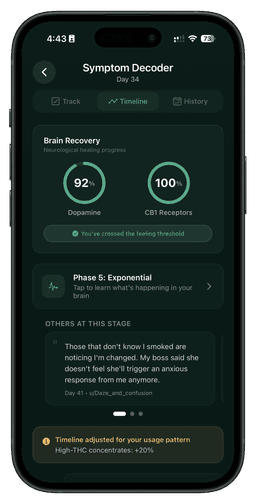
Anxiety after quitting cannabis peaks during the first week then substantially resolves by day 30–45 as CB1 receptors in the amygdala recover. Post-cessation anxiety is reported by 70–80% of people who quit and is the direct result of CB1 receptor downregulation in the brain’s fear processing centers. Research using PET imaging confirms CB1 receptors begin recovering within days of abstinence and return to near-normal density by day 28 (Hirvonen et al., Molecular Psychiatry, 2012). As multiple studies confirm, “cannabis use can both increase and reduce anxiety in humans” (Fusar-Poli et al., Archives of General Psychiatry, 2009). The withdrawal anxiety is temporary — it reflects partial recovery, not your true baseline. Many people who push through report anxiety levels dropping below their pre-cannabis baseline by weeks 4–8.
Anxiety is one of the most common withdrawal symptoms, reported by 70–80% of people who quit cannabis. This is the direct result of CB1 receptor downregulation.
When you stop using cannabis, your brain has fewer CB1 receptors and your natural endocannabinoid system is impaired. Anxiety signaling in the amygdala is essentially unregulated. This creates a period of heightened anxiety that typically:
- Begins: Within the first 1–3 days
- Peaks: Around days 3–7
- Gradually improves: Over weeks 2–4
- Substantially resolves: By day 30–45 for most people
The critical insight is that this withdrawal anxiety is temporary. Research shows that CB1 receptors begin recovering within days of cessation and return to near-normal density by day 28. As your receptors recover, your natural anxiety regulation comes back online.
This is why the Valley of Disappointment between weeks 4–6 is so dangerous. Many people quit, experience worse anxiety than they had while using, and conclude that they "need" cannabis for their anxiety. In reality, the cannabis caused the anxiety deficit, and their brain just needs more time to heal.
Evidence-Based Alternatives for Anxiety
Cognitive Behavioral Therapy (CBT)
The gold standard for anxiety treatment. Multiple meta-analyses show CBT is as effective as medication for most anxiety disorders, with longer-lasting effects. Unlike cannabis, the benefits increase over time rather than requiring escalating doses.
Exercise
A 2018 review in Sports Medicine found that regular exercise significantly reduces anxiety symptoms, with effects comparable to medication for mild-to-moderate anxiety. Exercise also supports the endocannabinoid system — your body increases anandamide production during aerobic activity (the "runner's high").
Mindfulness-Based Stress Reduction (MBSR)
Research supports MBSR for anxiety management. This is also the foundation of craving surfing, which helps manage both cravings and anxiety during cannabis withdrawal.
Professional support
If anxiety significantly impacts your daily life, a mental health professional can help determine whether you have an anxiety disorder that needs treatment independent of cannabis use. Some people do have pre-existing anxiety that was masked (not treated) by cannabis — these individuals may benefit from targeted treatment as they quit.
Frequently Asked Questions
Does CBD help with anxiety without the THC problems?
CBD shows some promise for anxiety in preliminary research, but results are mixed. CBD does not bind directly to CB1 receptors and does not cause the same tolerance/dependence cycle as THC. However, the evidence base is still limited, and many CBD products are poorly regulated.
I have been using weed for anxiety for years. Is my anxiety real or caused by cannabis?
Likely both. You may have had baseline anxiety that led you to cannabis, and chronic use has almost certainly worsened it through CB1 downregulation. The only way to know your true baseline anxiety level is to quit and allow your endocannabinoid system to fully recover (approximately 4–8 weeks). If significant anxiety persists after 60–90 days of abstinence, it is likely a pre-existing condition worth treating with evidence-based approaches.
Why does weed sometimes cause panic attacks?
High doses of THC can overstimulate the amygdala rather than calm it. This is especially common with high-potency products, edibles (which have delayed and unpredictable onset), and in unfamiliar or stressful environments. Genetics play a role too — variants in the FAAH gene affect how quickly your body breaks down anandamide and influence sensitivity to THC.
How long does anxiety last after quitting weed?
Acute withdrawal anxiety typically peaks in the first week and substantially improves by day 30. Some people experience residual anxiety for 2–3 months as their endocannabinoid system fully normalizes. Tracking your symptoms with Klar helps you see the improvement trend even when individual days feel difficult.