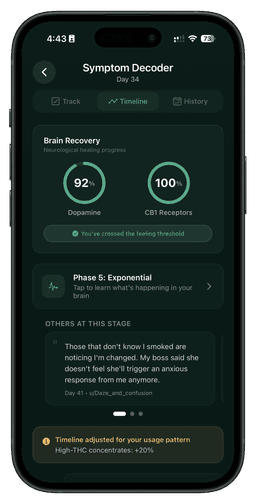
When you’re in the middle of withdrawal — sleepless, irritable, craving — the benefits of quitting can feel abstract. But the science is clear: your brain and body begin healing within hours of your last use, and the improvements compound over weeks and months. Here’s what the research shows you can expect.
Brain & Cognitive Benefits
Cognitive benefits of quitting cannabis begin within the first week and continue improving for months, with verbal memory showing the most dramatic recovery. A study at Massachusetts General Hospital found that “cannabis abstinence is associated with improvements in verbal learning that appear to occur largely in the first week following last use” (Schuster et al., Journal of Clinical Psychiatry, 2018). The research demonstrated that participants who abstained “had better memory overall and at weeks 1, 2, 3” compared to those who continued using. CB1 receptor recovery in the hippocampus — the brain’s memory center — begins within 48 hours (Hirvonen et al., Molecular Psychiatry, 2012), while dopamine system normalization over 4–12 weeks restores motivation and the ability to feel pleasure from everyday activities.
Memory and Learning
THC impairs the hippocampus — the brain region responsible for forming new memories. Studies published in JAMA Internal Medicine found that regular cannabis users showed measurable deficits in verbal memory, with memory performance improving significantly within 72 hours of cessation and continuing to improve over several weeks.
As Dr. Randi Schuster of Massachusetts General Hospital and Harvard Medical School documented, “cannabis abstinence is associated with improvements in verbal learning that appear to occur largely in the first week following last use.” Her study of 88 regular cannabis users showed that abstaining participants “had better memory overall and at weeks 1, 2, 3” compared to those who continued using (Schuster et al., Journal of Clinical Psychiatry, 2018).
By day 30, most people report noticeably sharper memory. By day 90, cognitive testing shows performance returning to near-baseline in most users.
Focus and Executive Function
The prefrontal cortex — responsible for planning, decision-making, and impulse control — is heavily affected by chronic THC exposure. Brain fog is one of the most common withdrawal symptoms because the prefrontal cortex is recalibrating.
Research shows executive function begins improving within 1–2 weeks and continues improving for months. Many people describe the experience as "waking up from a fog" or "getting my brain back."
Motivation and Drive
The "amotivational syndrome" associated with chronic cannabis use is directly linked to dopamine system dysregulation. When you quit, dopamine systems gradually normalize over 4–12 weeks. Activities that felt pointless during active use start feeling rewarding again. Goals feel achievable. The flat, grey quality of life lifts.
Sleep Benefits
Cannabis appears to help sleep in the short term — it reduces the time to fall asleep and increases total sleep time. But it does so at a cost: THC suppresses REM sleep, the phase critical for emotional processing, memory consolidation, and cognitive restoration.
When you quit, insomnia and vivid dreams hit hard initially (REM rebound). But by weeks 2–4, sleep architecture begins normalizing. Research published in Sleep Medicine Reviews shows that after 4–6 weeks of abstinence:
- REM sleep returns to normal duration and timing
- Sleep efficiency improves (less time lying awake)
- Sleep quality ratings increase significantly
- You feel more rested on the same hours of sleep
- Dreams return — vivid at first, then normalizing
Many people who quit say better sleep is the benefit they notice most. It changes everything downstream: energy, mood, focus, and resilience.
Physical Benefits
Respiratory Health
If you smoked cannabis, lung function improves within weeks. Cannabis smoke contains many of the same carcinogens and irritants as tobacco smoke. Studies show measurable improvement in FEV1 (a key lung function measure) within 30 days of cessation. Chronic cough, phlegm production, and shortness of breath resolve for most people within 1–3 months.
Appetite Regulation
THC artificially stimulates appetite by activating CB1 receptors in the hypothalamus. Appetite drops initially after quitting (usually 1–2 weeks), but then normalizes. Many people find that food tastes better after a few weeks because their palate recalibrates, and they develop healthier eating patterns without THC-driven overeating.
Fitness and Physical Performance
Higher VO2 max, better cardiovascular performance, and improved exercise recovery. Cannabis reduces motivation to exercise and impairs motor coordination. After quitting, people consistently report increased exercise frequency and better performance. Exercise also accelerates recovery by boosting natural endocannabinoid production.
Hormonal Balance
Research suggests chronic cannabis use can affect testosterone levels, cortisol regulation, and reproductive hormones. These markers tend to normalize within 4–8 weeks of cessation.
Mental Health Benefits
Quitting cannabis produces measurable mental health improvements, with both anxiety and depression dropping below pre-cessation levels within 4–8 weeks. Chronic cannabis use disrupts the GABA/glutamate balance and sensitizes the amygdala, paradoxically worsening the anxiety it is often used to treat. A meta-analysis in The Lancet Psychiatry (2019) found cannabis use associated with a 1.3-fold increased risk of developing anxiety disorders. After the initial withdrawal spike (days 3–10), anxiety levels typically decline below pre-quitting baselines by weeks 4–8 as CB1 receptors in the amygdala recover. Longitudinal research shows people who quit cannabis report significant improvements in depressive symptoms by 6 weeks, with continued improvement at 6 months.
Anxiety
This one is counterintuitive for many people. Cannabis is often used to self-medicate anxiety, but chronic use actually worsens baseline anxiety over time. THC disrupts the GABA/glutamate balance and sensitizes the amygdala. After the initial withdrawal spike (days 3–10), anxiety levels typically drop below pre-quitting baselines by weeks 4–8.
Depression
Similarly, depression worsens temporarily during withdrawal (dopamine deficit) but then improves beyond pre-cessation levels. A longitudinal study found that people who quit cannabis reported significant improvements in depressive symptoms by 6 weeks, with continued improvement at 6 months.
Emotional Range
One of the most profound benefits is the return of the full emotional spectrum. Chronic cannabis use blunts both negative and positive emotions. After quitting, people describe crying at movies again, laughing harder, feeling genuine excitement, and experiencing deeper connection with others. The emotional flatness lifts as the endocannabinoid system rebalances.
Clarity and Self-Awareness
Many people report a clarity of thinking and self-awareness that they did not realize they were missing. Decisions feel more intentional. The gap between intention and action shrinks. Self-reflection becomes more accessible.
Relationships, Career & Finances
Relationships
Cannabis can create emotional distance. When you quit, people consistently report deeper conversations, more patience, better conflict resolution, and more present engagement with partners, friends, and family. The return of emotional range makes intimacy more accessible.
Career and Productivity
Improved focus, motivation, and executive function translate directly to work performance. Many people report better reviews, new opportunities, and the confidence to pursue goals they had been putting off. The compounding effect of small daily improvements adds up quickly.
Finances
Cannabis is expensive. A daily user spending $10–20/day saves $300–$600/month, or $3,600–$7,200/year. Many people are shocked at the total when they calculate their annual spending. Klar tracks cannabis-free money saved as a visible reminder of this benefit.
Time
Beyond the time spent consuming cannabis, there is the time lost to lower productivity, longer sleep, and reduced initiative. People who quit commonly describe "gaining hours" in their day — hours that compound into reading, exercise, hobbies, side projects, and relationships.
When Do Benefits Appear? A Timeline
| Timeframe | Benefits |
|---|---|
| 24–72 hours | Blood THC levels drop. Lung function begins improving (if smoked). Initial memory improvements. |
| 1 week | Appetite starts normalizing. Physical withdrawal symptoms peak then begin declining. First noticeable cognitive improvements. |
| 2 weeks | Sleep starts improving. Brain fog lifting. Cravings becoming less frequent. Energy returning. |
| 1 month | Significant cognitive improvement. Sleep architecture normalizing. Emotional range returning. Respiratory symptoms resolved. |
| 2 months | Dopamine regulation substantially recovered. Motivation returning. Anxiety and depression below pre-cessation levels. Exercise capacity improved. |
| 3 months | CB1 receptors near-fully recovered. Cognitive function at baseline. Cravings rare. Full emotional range. Sleep normalized. |
| 1 year | Compounding life benefits: financial savings, relationship improvements, career progress, new habits and identity consolidated. |
Is It Worth It?
The first few weeks are hard. Withdrawal is real. The Valley of Disappointment is brutal. But the benefits are not hypothetical — they are physiological, measurable, and documented.
Most people who make it to day 90 say the same thing: "I wish I had done this sooner." Not because the process was easy, but because the person they became on the other side was worth the discomfort of getting there.
If you are considering quitting or are in the early stages of recovery, tracking your progress helps you see benefits as they emerge rather than waiting to "feel different." Klar visualizes your brain recovery, tracks your symptoms, and shows you exactly how far you have come — because on the hard days, the data is more trustworthy than your feelings.