Anxiety After Quitting Weed
Last updated: January 31, 2026
Heightened anxiety is one of the most common and persistent cannabis withdrawal symptoms, driven by GABA/glutamate imbalance and cortisol dysregulation.
50-70% of people quitting cannabis
Peaks day 5
~Peaks day 30
Recovery Timeline
| Metric | Value |
|---|---|
| Prevalence among quitters | 50-70% of people quitting cannabis |
| Typical onset | Day 1 |
| Peak intensity | Day 5 |
| Expected resolution | ~Day 30 |
| Total duration | 29 days (approximate) |
Your heart is racing. Your chest feels tight. Your mind is spinning through worst-case scenarios about things that didn’t bother you last week. If you recently quit cannabis, you’re experiencing one of the most common withdrawal symptoms — and there’s a specific neurological reason it’s happening.
Why Quitting Weed Causes Anxiety
Cannabis has complex effects on anxiety. Many people use it specifically because it reduces anxiety. THC (at low-moderate doses) enhances GABA activity — your brain’s primary inhibitory neurotransmitter — producing a calming effect. It also temporarily reduces activity in the amygdala, the brain’s fear center.
With regular use, your brain adapts in two critical ways:
- GABA receptor downregulation. Your brain reduces its sensitivity to GABA because THC has been doing the calming work. When THC is removed, you have less natural calming capacity.
- Glutamate upregulation. Glutamate is the excitatory counterpart to GABA. Your brain upregulates it to compensate for THC’s sedating effects. When cannabis is removed, you’re left with excess excitation and insufficient inhibition.
The result is a temporary state of neurological hyperexcitability. Your brain is in overdrive. This manifests as anxiety, restlessness, racing thoughts, and sometimes panic attacks. Add cortisol dysregulation (withdrawal spikes cortisol levels) and you have a perfect storm for anxiety.
When Does It Start, Peak, and End?
- Onset: Day 1–2. Anxiety often appears within 24 hours of your last use.
- Peak: Days 3–7. This is typically the most intense period. Some people experience full panic attacks during this window.
- Gradual improvement: Days 7–21. Anxiety decreases as GABA/glutamate balance starts restoring.
- Resolution: Days 21–45 for most. If you had pre-existing anxiety before cannabis use, some baseline anxiety will remain (and should be addressed separately).
What Actually Helps
1. Box Breathing (Immediate Relief)
When anxiety spikes: inhale 4 seconds, hold 4 seconds, exhale 4 seconds, hold 4 seconds. Repeat 4–8 cycles. This activates the parasympathetic nervous system and directly counters the fight-or-flight response. It works within 60–90 seconds.
2. Vigorous Exercise
Exercise is the single most effective natural anxiolytic. A 30-minute run or intense workout reduces anxiety for 4–6 hours afterward by burning off excess cortisol and norepinephrine, and boosting GABA naturally. During withdrawal, exercise should be treated as non-negotiable medicine.
3. Limit Caffeine
Your nervous system is already in overdrive. Caffeine adds fuel to the fire. Cut your intake by at least 50% during the first 2 weeks of withdrawal, or eliminate it entirely. Switch to decaf or herbal tea. You can reintroduce caffeine once anxiety stabilizes.
4. Cold Exposure
A cold shower (even 30 seconds at the end of a warm shower) triggers a strong parasympathetic response. It’s uncomfortable, but it breaks the anxiety loop immediately. Some people find this more effective than breathing exercises.
5. Name It to Tame It
When anxiety hits, say (out loud or internally): “This is withdrawal anxiety. My GABA receptors are recalibrating. This is temporary and it means my brain is healing.” Labeling emotional states activates the prefrontal cortex and reduces amygdala reactivity. Neuroscience confirms this works.
6. Craving Surfing
If your anxiety is driving cravings to use again, try craving surfing — a technique where you observe the craving as a wave that rises, peaks, and passes within 15–20 minutes. Don’t fight it or feed it; just watch.
When to Seek Professional Help
- Panic attacks are frequent (multiple per day) or increasing in severity
- Anxiety is causing you to isolate completely from others
- You’re having suicidal thoughts or self-harm urges
- Anxiety was present before cannabis use and has significantly worsened
Crisis Text Line: Text HOME to 741741
SAMHSA National Helpline: 1-800-662-4357 (free, confidential, 24/7)
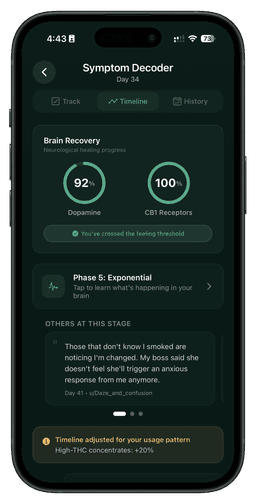
Track your progress
See your brain healing in real time
Klar tracks 47 withdrawal symptoms and visualizes your dopamine and CB1 receptor recovery day by day.
Related Symptoms
Related Timeline
Medical Disclaimer: This content is for informational purposes only and does not constitute medical advice, diagnosis, or treatment. Always consult a qualified healthcare provider for medical guidance. If you are in crisis, call 988 (Suicide & Crisis Lifeline) or text HOME to 741741.