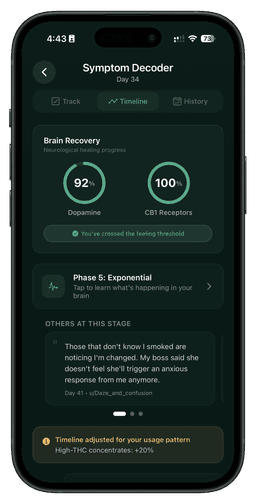
You're 30 days in. The night sweats are gone. You can sleep again (mostly). The worst of the physical withdrawal is behind you. But something is wrong. You expected to feel better by now. Instead, you feel… nothing. Flat. Grey. Like you traded chaos for emptiness.
Welcome to the Valley of Disappointment. It's the most dangerous phase of cannabis recovery—and almost nobody warns you about it.
What Is the Valley of Disappointment?
The Valley of Disappointment is the most dangerous phase of cannabis recovery, occurring between days 21–45 when acute withdrawal has resolved but dopamine recovery is incomplete. During this phase, CB1 receptor density has recovered substantially (Hirvonen et al., Molecular Psychiatry, 2012), but dopamine baseline remains below normal, producing anhedonia — a flat, grey emotional state where nothing feels rewarding. Cannabis withdrawal is characterized by “a time-dependent constellation of symptoms: irritability, anxiety, marijuana craving, decreased quality and quantity of sleep, and decreased food intake” (Haney, Current Psychiatry Reports, 2005). This gap between “no longer in acute distress” and “not yet feeling good” is where the majority of relapses occur.
The term comes from James Clear's Atomic Habits, but we've adapted it specifically for cannabis recovery. It describes the gap between Days 21–45 when:
- Acute withdrawal symptoms have resolved
- But neurological recovery is still in progress
- Resulting in a "grey zone" where you've lost the urgency to quit but haven't yet gained the benefits of recovery
You've made it through the dramatic, painful first weeks. Now the challenge isn't physical pain—it's the quiet voice saying, "What's the point?"
Why It Happens: The Neuroscience
At Day 28, your CB1 receptor density has recovered substantially. But your dopamine system is lagging behind. Here's the mismatch:
Your endocannabinoid system is functional enough that you're not in acute distress. But your dopamine baseline—the thing that makes everyday activities feel rewarding—is still below normal. Music doesn't hit the same. Food is just fuel. Sunsets are just… sunsets.
This is called anhedonia—the inability to feel pleasure. It's a well-documented phase of dopamine recovery, not just in cannabis but in recovery from any substance that hijacks the reward system. The good news: it's temporary. Dopamine synthesis capacity continues climbing through Day 60–90.
As Dr. Margaret Haney of Columbia University, one of the leading researchers on cannabis withdrawal, explains, cannabis abstinence is “characterized by a time-dependent constellation of symptoms: irritability, anxiety, marijuana craving, decreased quality and quantity of sleep, and decreased food intake” (Current Psychiatry Reports, 2005). The anhedonia phase is a predictable part of this constellation — not a sign that recovery isn’t working.
But knowing it's temporary doesn't make it feel temporary when you're living it.
What It Feels Like
People in the Valley describe it as:
- "I'm not sad. I'm not happy. I'm just… here."
- "I know I should feel proud, but I just feel empty."
- "Is this what sober life is? Because it sucks."
- "Everything was easier with weed. At least I could enjoy things."
- "I feel like I'm living in black and white."
These feelings are neurological, not philosophical. Your brain isn't telling you the truth about what sober life feels like—it's telling you what partial recovery feels like. The full picture hasn't loaded yet.
Why People Relapse Here
The Valley of Disappointment between weeks 4–6 of cannabis cessation is the peak relapse window because the motivational urgency of acute withdrawal has faded while neurological recovery remains incomplete. Dopamine synthesis capacity in the striatum is still recovering during this period (Bloomfield et al., Molecular Psychiatry, 2016), producing anhedonia that makes people question whether quitting is worthwhile. As Dr. Margaret Haney of Columbia University Medical Center has documented, cannabis abstinence produces “characteristic withdrawal symptoms (negative mood, anorexia and dreaming) relative to cannabis administration” (Haney et al., Addiction Biology, 2022). Three cognitive traps converge: faded urgency, memory romanticization, and the dangerous belief that moderate use is possible.
The Valley is the peak relapse window for three reasons:
1. The urgency is gone. During acute withdrawal, the pain is motivating. You can clearly feel why you're quitting. In the Valley, the pain has faded but so has the motivation.
2. Romanticization kicks in. Your brain starts editing memories of cannabis use. You remember the relaxation, the laughter, the creativity—and forget the 3 AM anxiety, the lost motivation, the money burned. This is your dopamine-depleted brain searching for a reliable reward source.
3. "I can probably moderate." The most dangerous thought in recovery. Your brain convinces you that the problem was overuse, not use—and that you can now use "responsibly." For most people with cannabis dependency, this leads directly back to daily use within weeks.
7 Strategies to Push Through
1. Know you're in the Valley
Simply naming it reduces its power. When you feel flat and unmotivated, say to yourself: "This is the Valley. It's mapped. It's expected. It ends." Check your position on the 90-day timeline—you're likely between Day 25–45.
2. Look backward, not forward
Open your symptom tracker. Look at Day 1. Look at Day 7. Compare it to today. The progress is invisible when you're living it, but it's obvious in the data. You're dramatically better than you were, even if you don't feel "good" yet.
3. Exercise is non-negotiable
This is the single most effective intervention for anhedonia. Exercise directly stimulates dopamine and endorphin production—the exact neurotransmitters you're deficient in. 30 minutes of moderate exercise has a measurable effect on mood that lasts 24 hours.
4. Pursue micro-pleasures
Don't wait for big joy. Stack small pleasures: a hot shower, your favorite meal, sunlight on your face, a good song, a walk in nature. You're rebuilding your reward system—start with the small circuits.
5. Connect with others
Isolation intensifies anhedonia. Talk to someone who gets it—r/leaves on Reddit, a counselor, a friend who's been through it. Simply being heard activates oxytocin pathways that counteract dopamine depletion.
6. Commit to a future date
Tell yourself: "I will not evaluate whether this was worth it until Day 90." You wouldn't judge a marathon by how you feel at mile 18. You're in the hardest stretch, not at the finish line.
7. Remember your reason
Why did you quit? Write it down and put it somewhere you'll see it daily. During the Valley, your brain will try to erase this. Don't let it. Your past self made this decision for good reasons. Trust that person.
What's on the Other Side
Everyone who survives the Valley reports the same thing: around Day 50–60, color starts returning. Music sounds better. Food tastes richer. Laughter comes unprompted. You wake up one morning and realize you feel… clear. Not high. Not numb. Clear.
The people who make it through the Valley have dramatically higher long-term success rates. You're not starting over—you're exactly on schedule. The Valley is the price of admission to the life that's waiting on the other side.
Keep going. It's worth it.