Cravings After Quitting Weed
Last updated: January 31, 2026
Intense urges to use cannabis are driven by your brain's conditioned reward pathways and can be managed with evidence-based techniques like craving surfing.
70-80% of people quitting cannabis
Peaks day 5
~Peaks day 60
Recovery Timeline
| Metric | Value |
|---|---|
| Prevalence among quitters | 70-80% of people quitting cannabis |
| Typical onset | Day 1 |
| Peak intensity | Day 5 |
| Expected resolution | ~Day 60 |
| Total duration | 59 days (approximate) |
The urge hits out of nowhere. Every cell in your body seems to want one thing. Your brain is generating a compelling narrative about why “just one time” would be fine. Cannabis cravings are the single most common withdrawal symptom and the #1 reason people relapse. But cravings follow predictable patterns — and once you understand them, you can outlast them.
Why Your Brain Craves Weed
Cravings aren’t about willpower. They’re a conditioned neurological response driven by your brain’s reward prediction system.
Every time you used cannabis, your brain released dopamine and encoded a memory: this stimulus → reward. Over months or years of use, your brain built a massive network of associations:
- Stress → smoke to relax
- Boredom → smoke to feel something
- Evening time → smoke to unwind
- Seeing friends → smoke to be social
- Music, food, certain locations → smoke to enhance
These associations are encoded in the dorsal striatum — the habit center. When you encounter any of these triggers after quitting, your brain fires the same reward-prediction signal it always has. The result is a powerful urge that feels physical, urgent, and impossible to ignore.
The critical fact: each craving lasts 15–20 minutes. Brain imaging shows that the neurological cascade behind a craving peaks at 5–10 minutes and resolves within 20. If you can ride it out, it passes. Every time you ride one out without using, the association weakens slightly.
When Do Cravings Start, Peak, and End?
- Onset: Day 1. Cravings begin almost immediately.
- Peak intensity: Days 3–7. Cravings are most frequent and most intense during the first week.
- Decreasing frequency: Days 7–30. Cravings become less frequent but can still be intense when triggered.
- Sporadic: Days 30–90. Occasional cravings triggered by specific situations. Less intense, shorter duration.
- Rare: After 90 days. Most people experience only occasional mild urges, often triggered by very specific memories or situations.
Cravings are the longest-lasting withdrawal symptom, but their character changes. Early cravings are constant and physiological. Late-stage cravings are situational and psychological. Different strategies work for each.
What Actually Helps
1. Craving Surfing
The most evidence-based technique for managing cravings. Instead of fighting the urge or giving in, observe it like a wave: it rises, peaks, and falls. Sit with it. Notice where you feel it in your body. Watch it change. Set a 20-minute timer if needed. Read our full guide on the science of craving surfing.
2. Change Your Physical State
When a craving hits, immediately change your physiology: cold water on your face, intense exercise, a cold shower, or even holding ice cubes. This activates your body’s dive reflex and interrupts the craving neural pattern.
3. Identify and Remove Triggers
Map your triggers: when do cravings hit? With whom? Where? What emotional state? Then modify your environment. Remove paraphernalia (all of it). Avoid stoner friends during the first 30 days. Change your evening routine. Remove the cues that fire the craving response.
4. Play the Tape Forward
When your brain says “just once would be fine,” play the entire tape: you smoke, feel relief for 2 hours, then feel guilt, reset your timer, lose momentum, and end up back at day 1. The craving only shows you the reward; force yourself to see the full sequence.
5. HALT + B
Cravings intensify when you’re Hungry, Angry, Lonely, Tired, or Bored. Address the underlying state first. Often the craving diminishes once the real need is met.
When to Seek Professional Help
- Cravings are constant and overwhelming despite using these techniques
- You’ve relapsed multiple times and can’t get past the first week
- Cannabis use was connected to trauma processing (cravings may indicate unresolved trauma)
- You want professional support — CBT and motivational interviewing are highly effective for cannabis cravings
SAMHSA National Helpline: 1-800-662-4357 (free, confidential, 24/7)
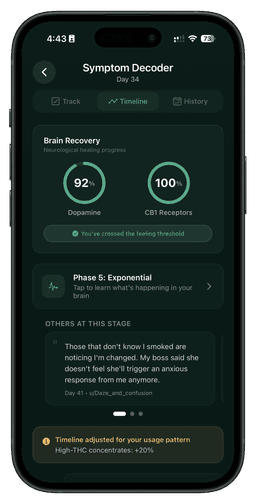
Track your progress
See your brain healing in real time
Klar tracks 47 withdrawal symptoms and visualizes your dopamine and CB1 receptor recovery day by day.
Related Symptoms
Medical Disclaimer: This content is for informational purposes only and does not constitute medical advice, diagnosis, or treatment. Always consult a qualified healthcare provider for medical guidance. If you are in crisis, call 988 (Suicide & Crisis Lifeline) or text HOME to 741741.