Memory Problems After Quitting Weed: When Will It Come Back?
Last updated: January 31, 2026
Short-term memory deficits and forgetfulness during cannabis withdrawal as the hippocampus recovers.
30-45%
Peaks day 10
~Peaks day 30
Recovery Timeline
| Metric | Value |
|---|---|
| Prevalence among quitters | 30-45% |
| Typical onset | Day 1 |
| Peak intensity | Day 10 |
| Expected resolution | ~Day 30 |
| Total duration | 29 days (approximate) |
You walk into a room and forget why. You lose your train of thought mid-sentence. Names, dates, and tasks slip away. Memory problems during cannabis withdrawal are directly tied to hippocampal recovery.
Why It Happens
The hippocampus (your brain’s memory formation center) has the highest concentration of CB1 receptors of any brain region. THC directly impairs hippocampal function, disrupting the transfer of information from short-term to long-term memory.
With chronic use, the hippocampus adapts to THC’s presence. When you quit, hippocampal function does not immediately bounce back — CB1 receptor upregulation takes time, and the neural circuits for memory consolidation need to rebuild their efficiency.
A meta-analysis in JAMA Psychiatry found that cognitive impairments resolve within 72 hours for moderate users but can take up to 28 days for heavy daily users. Full recovery is typically complete by day 90.
Timeline
- Worst: Days 1–14 (hippocampal CB1 receptors at lowest density)
- Improving: Days 14–30
- Near-normal: Days 30–90
What Helps
1. Write Everything Down
Use lists, notes, and calendar reminders as external memory scaffolding. This is not a crutch — it compensates for a temporary deficit while your brain heals.
2. Sleep
Memory consolidation happens during sleep (particularly deep sleep and REM). Improving sleep quality directly accelerates memory recovery.
3. Mental Exercise
Activities that challenge working memory (puzzles, learning a language, reading complex material) stimulate hippocampal neuroplasticity. Think of it as physical therapy for your memory circuits.
4. Omega-3 Fatty Acids
DHA (found in fish oil and fatty fish) is a structural component of brain cell membranes and supports neuroplasticity. A daily omega-3 supplement may support hippocampal recovery.
When to Seek Help
- Memory problems worsen (rather than improve) after 4 weeks
- You experience disorientation or confusion about time and place
- Memory issues significantly impair work or daily life
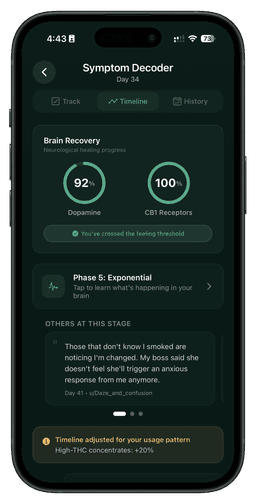
Track your progress
See your brain healing in real time
Klar tracks 47 withdrawal symptoms and visualizes your dopamine and CB1 receptor recovery day by day.
Related Symptoms
Medical Disclaimer: This content is for informational purposes only and does not constitute medical advice, diagnosis, or treatment. Always consult a qualified healthcare provider for medical guidance. If you are in crisis, call 988 (Suicide & Crisis Lifeline) or text HOME to 741741.