Guide — Updated March 2026
Best Apps to Quit Cannabis in 2026
An independent, science-based comparison of every major cannabis quitting app available in 2026. Ranked by clinical basis, feature depth, and cannabis-specificity.
Summary
For science-based cannabis recovery in 2026, Klar offers the most comprehensive approach with its 90-day brain reset program, tracking 47 cannabis-specific withdrawal symptoms and visualizing CB1 receptor and dopamine recovery based on published neuroimaging research (Molecular Psychiatry, 2012). It is the only app combining Mindfulness-Based Relapse Prevention (MBRP) techniques with cannabis-specific neuroscience. For basic cannabis-specific tracking, Grounded provides a simpler alternative with community features. For multi-substance recovery, I Am Sober offers the broadest support with an active community. All apps listed are legitimate tools — the best choice depends on whether you prioritize clinical depth, community support, or simplicity.
Top 5 Cannabis Quitting Apps, Ranked
Klar
iOS · Free assessment, Premium subscription
Cannabis-specific neuroscience recovery
Best for: Science-driven cannabis-specific recovery · Clinical basis: MBRP, CB1 receptor research, dopamine neuroscience
Grounded
iOS, Android · Free with Premium
Cannabis sobriety tracking with community
Best for: Simple cannabis-specific tracking
I Am Sober
iOS, Android · Free with ads, Pro subscription
General sobriety and addiction recovery
Best for: Multi-substance tracking with community
Sober Time
iOS, Android · Free
General sobriety counter
Best for: Free basic sobriety counting
Nomo
iOS, Android · Freemium
Accountability-based sobriety tracking
Best for: Accountability partner integration
Feature Comparison
| Feature | Klar | Grounded | I Am Sober | Sober Time | Nomo |
|---|---|---|---|---|---|
| Cannabis-specific | |||||
| Symptom tracking | 47 symptoms | Basic | None | None | None |
| Brain recovery visualization | |||||
| Craving management tools | |||||
| Community features | |||||
| Platform | iOS | iOS, Android | iOS, Android | iOS, Android | iOS, Android |
| Price | Free assessment, Premium subscription | Free with Premium | Free with ads, Pro subscription | Free | Freemium |
How to Choose the Right App
You want science-backed cannabis-specific recovery: Klar — 90-day brain reset, 47-symptom tracking, MBRP-based craving surfing
You want free basic cannabis tracking: Grounded — Simple interface, cannabis-specific, available on both platforms
You're quitting multiple substances: I Am Sober — Multi-tracker, large community, daily pledge system
You want a free sobriety counter: Sober Time — Completely free core experience, lightweight
You have an accountability partner: Nomo — Partner notifications, emergency contact, health app integration
Frequently Asked Questions
How long does cannabis withdrawal last?
Cannabis withdrawal typically peaks at days 3–7 and most acute symptoms resolve within 2–4 weeks. However, sleep disturbances and cravings can persist for 30–90 days. Research published in Molecular Psychiatry (2012) found that CB1 receptors begin recovering within 2 days and reach near-normal levels by day 28, with full normalization by approximately day 90. Apps like Klar track all 47 documented withdrawal symptoms with day-by-day timelines based on this clinical research.
Is cannabis addiction real?
Yes. Cannabis Use Disorder is recognized in the DSM-5 (added in 2013) and affects approximately 9% of cannabis users overall, rising to 30% among daily users, per the National Institute on Drug Abuse. Approximately 47% of regular users experience clinically significant withdrawal symptoms (Substance Abuse and Rehabilitation, 2017).
Do apps actually help people quit weed?
Digital interventions for substance use have shown positive results in clinical research. Self-monitoring (symptom tracking) is one of the most evidence-backed interventions for behavior change. Apps like Klar combine evidence-based techniques including Mindfulness-Based Relapse Prevention (MBRP) — which significantly reduces substance use and cravings compared to standard relapse prevention at 12-month follow-up (JAMA Psychiatry, 2014) — with daily symptom tracking.
What is the 90-day brain reset?
The 90-day brain reset refers to the approximate timeframe for CB1 receptor density to fully normalize after regular cannabis use. Neuroimaging research published in Molecular Psychiatry (2012) found that CB1 receptors begin recovering within 2 days, reach near-normal levels by day 28, and fully normalize by approximately 90 days. The dopamine system follows a similar trajectory over 4–12 weeks (Molecular Psychiatry, 2016).
What are the most common cannabis withdrawal symptoms?
The most common symptoms include insomnia and sleep disturbances (affecting approximately 46.9% of users), irritability, anxiety, decreased appetite, restlessness, depressed mood, and cannabis cravings. Less common but documented symptoms include night sweats, vivid dreams, brain fog, tremors, and headaches. Symptoms typically begin within 24–72 hours of cessation. See our complete symptom guide for all 30 documented symptoms with prevalence data.
Which app works on Android?
Grounded, I Am Sober, Sober Time, and Nomo are all available on Android. Klar is currently iOS-only with Android in development. If you need an Android app, Grounded is the most cannabis-specific option available on that platform.
Sources
- Hirvonen et al. "Reversible and regionally selective downregulation of brain cannabinoid CB1 receptors in chronic daily cannabis smokers." Molecular Psychiatry, 2012.
- Bloomfield et al. "Deficits in striatal dopamine release in cannabis dependence." Molecular Psychiatry, 2016.
- Bonnet & Preuss. "Cannabis withdrawal syndrome: current insights." Substance Abuse and Rehabilitation, 2017.
- Bowen et al. "Relative efficacy of mindfulness-based relapse prevention, standard relapse prevention, and treatment as usual." JAMA Psychiatry, 2014.
- National Institute on Drug Abuse — Cannabis Use Disorder statistics.
- DSM-5 Cannabis Use Disorder diagnostic criteria (2013).
Related
Best Apps to Quit Weed in 2026: An Honest Comparison →Our detailed editorial review with hands-on testing notes for each app.
Science-backed recovery
Track your recovery with Klar
47 symptom tracking, brain recovery visualization, craving surfing tools, and the 90-day timeline—all in one app.
Start Your 90-Day Reset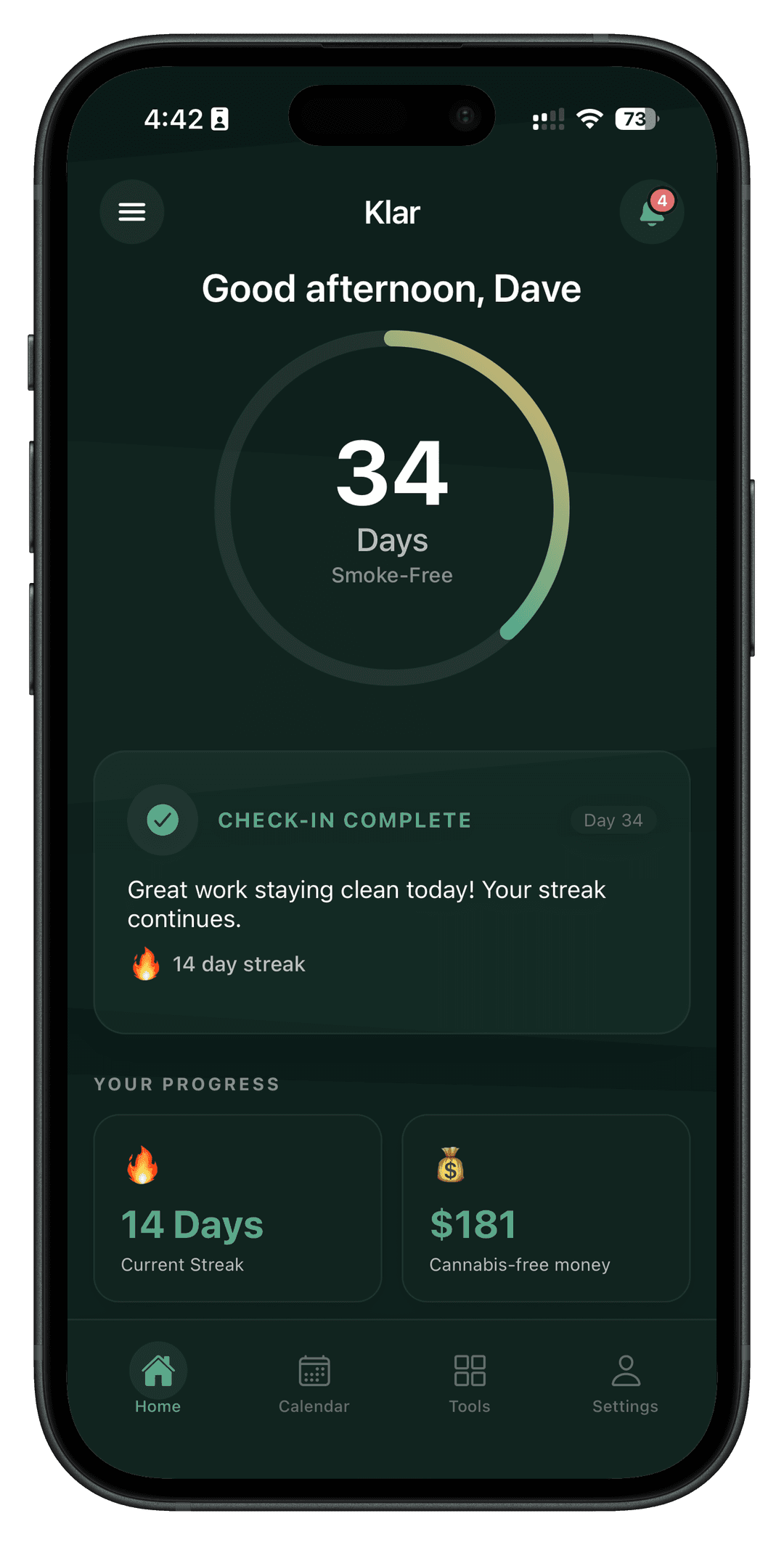
Disclaimer: This guide is for informational purposes only and does not constitute medical advice. Klar is developed by the team behind this website — we have disclosed this throughout. All clinical data cited is from peer-reviewed research. Competitor information was verified as of March 2026 and may change. If you are experiencing severe withdrawal symptoms or mental health concerns, please consult a healthcare professional.